January somehow feels longer than any other month. The holidays are behind us, the year is technically “new,” yet everything moves at a strange in-between pace. It’s the time when motivation is high, calendars are still empty, and the idea of finally getting organized feels both exciting and slightly overwhelming. If you’ve ever promised yourself that this will be the year your content stops feeling rushed, chaotic, or last-minute, this moment is exactly when that promise can turn into something practical.
Instead of jumping straight into posting, planning, and producing on autopilot, January gives you a rare pause to zoom out. It’s the ideal time to think about how your content actually gets made, from ideation to publishing, before the busy months kick in. A thoughtful content production flow isn’t about creating more content; it’s about creating a system that supports consistency, quality, and sanity across the entire year.
In this guide, we’ll show you how to design your 2026 content production flow in just one focused day. You’ll learn what makes a production system work long-term, how to align formats and goals across channels, and how to avoid the bottlenecks that slow teams down. By the end, you’ll have a clear framework and a ready-to-use template that helps you move into the year with a plan you can actually follow.
Key elements of a successful content production flow
A digital content strategy is the plan that connects what you publish to why you publish it and how it gets made. The “how” is where most strategies quietly fall apart: Content Marketing Institute found only 28% of enterprise marketers say their content strategy is extremely or very effective, while 61% call it only moderately effective.
A strong content production flow fixes that gap by turning strategy into an execution system, so the work ships on time, stays consistent, and gets smarter over the year.
Clear intake rules (so your calendar isn’t driven by chaos)
The least obvious failure point in content production is how requests enter the system. If “Can we post something about this today?” arrives through five different channels, you don’t have a workflow, you have vibes.
A high-performing intake step usually includes:
• A short, standardized brief (audience, purpose, CTA, channel, deadline)
• A priority rule (what gets fast-tracked vs. what waits)
• A single “front door” (form, template, or one dedicated request space)
Why it matters right now: marketing teams are under pressure to do more with less. Gartner survey results reported by The Wall Street Journal found 73% of marketers are being asked to deliver more with fewer resources.
If your intake is messy, that pressure shows up as last-minute work, skipped QA, and inconsistent output.
A format system that’s built for reuse (not one-offs)
A subtle content production upgrade is moving from “make a post” to “build a repeatable format.” Formats reduce decision fatigue and make quality more consistent without slowing you down.
This is also where repurposing becomes a system, not an afterthought: HubSpot reports 48% of social media marketers share similar/repurposed content across platforms with minor adaptations.
Translation: reuse is already common, your edge is doing it intentionally with designed variants, not copy-paste.
Quick check: if you have these, your format system is working
• 3-5 “core formats” you can produce every month
• A defined “hero → hub → help” or “pillar → clips → posts” cascade
• A rule for what gets refreshed vs. what gets created from scratch
Workflow design that prevents approval bottlenecks
Most production delays aren’t creative problems, they’re operational ones: scattered feedback, unclear approvers, and “final_final_v7” file nightmares. Wrike frames campaign execution as an operational layer built around intake, planning, execution, reporting, and optimization, and calls out approvals/feedback as a common place where execution breaks down.
A healthier content production flow designs approvals like a product:
• One feedback location, no “notes in DMs.”
• One owner who consolidates input to avoid conflicting edits
• Clear gates (draft → review → final) with time boxes
A measurable definition of “done” (so output = impact, not activity)
This one’s easy to miss: teams often track content production volume, but not whether production is moving the needle. HubSpot notes that sales (41%+) and web traffic are among the most common ways marketers measure content strategy success.
Your workflow should bake measurement in before you publish, so every asset has a job.
Practical “definition of done” examples:
• Social post: engagement target + click goal or save/share goal
• Video: retention target + CTA click-through
• Blog: traffic target + conversion action
A feedback loop that improves the system (not just the content)
A content production flow gets powerful when it learns. That means short retrospectives monthly or per campaign, where you capture:
• What slowed production (handoffs, unclear briefs, approvals)
• What formats performed best and why
• What you’ll standardize next month (templates, checklists, reuse rules)
CMI’s newer B2B research highlights that the biggest driver of improvement reported by marketers was strategy refinement (74%), ahead of factors like tech implementation. In other words, tools help, but the compounding gains come from routinely tightening the system.
Steps to design your content production flow
Designing a reliable content production flow is a system that turns strategy into actual output, frees up energy for more creative work, and helps teams avoid last-minute chaos. Based on frameworks used by leading content teams and research-backed best practices, here’s a step-by-step process you can follow.
Step 1: Identify your audience engagement strategies
Before anything else, knowing who you’re creating for and how they engage is essential. Audience engagement strategy goes beyond demographics. It includes preferences, content consumption habits, and channel-specific behavior. Start by asking:
• Where does your audience spend most of their time?
• What type of content do they interact with most (videos, short posts, long reads)?
• How do they respond to content at different stages of your funnel?
This isn’t just a planning exercise, it sets the foundation for every asset you produce.
And this is a perfect place to mention how Async Intelligence fits in naturally into your flow. Async can automatically tag engagement patterns and surface opportunities where content can perform better, think optimized posting times, engagement insights, and suggested tweaks to formats, without being pushy. It’s a way to make smarter decisions faster as part of this first step.
Step 2: Outline your content types and formats
Once you understand engagement, decide what you’ll make. This goes beyond “we need blogs and videos” and into formats that align with audience behavior and goals.
Common categories include:
• Hero content: big-ticket pieces that drive discovery and brand reach
• Hub content: regular, audience-centric posts that build loyalty
• Help content: educational pieces that answer specific questions and convert
Your formats define rhythm and consistency, and also make scaling easier because you’re building repeatable production patterns.
Step 3: Set clear goals and KPIs
Goals turn production into business impact. Instead of tracking how many pieces you produce, focus on what those pieces are meant to achieve.
Your KPIs might look like:
• Unique clicks from social → for awareness
• Social engagement rate → for community growth
• Conversion rate from video CTAs → for demand generation
Explicitly linking every piece of content to a KPI makes each asset accountable and gives you feedback loops you can measure and optimize over time.
Step 4: Audit current assets and gaps
Before you build something new, see what you already have. A content audit helps you:
• Identify high-performing assets you can repurpose
• See gaps in your calendar or audience journey
• Spot outdated content that needs refreshing
This is where strategy lays the groundwork for production instead of production driving strategy, a key distinction many teams miss.
Step 5: Map roles, workflows, and timelines
A flow is the system of how work gets done:
• Who edits?
• Who briefs?
• What’s the review path?
• What’s the timeline from draft to publish?
Stop guessing. Document a real process that includes handoffs, review periods, contingencies for delays, and task ownership. This minimizes bottlenecks and keeps projects moving smoothly.
Step 6: Build channel-specific production rules
Different channels require different production rhythms and assets. A video for LinkedIn isn’t the same as a TikTok clip, and a long-form article follows a different review path than a carousel post. Create simple checklists for each channel that answer:
• What format is required
• What’s the optimal length
• What’s the approval path
• What’s the distribution plan
This gives your team clarity and prevents rework or guesswork later.
Step 7: Plan distribution and promotion
Designing content is getting it in front of the right audience. Planning your promotion flow ensures content doesn’t just sit live:
• Schedule social pushes
• Line up email blasts if relevant
• Identify repurposing opportunities
• Assign amplification tasks to owners
Integrating distribution planning into your content flow prevents your calendar from looking like a publishing silo disconnected from reaching goals.
Once you’ve completed these steps, your content production flow becomes a living system that’s aligned with audience behavior, tied to measurable outcomes, and designed for consistency, not chaos.
Social media content production tips
Social platforms move fast, but strong social media content production isn’t about chasing every new trend, it’s about designing a system that can keep up without burning out. Based on recent platform data, creator economy research, and how high-performing teams actually work, here are practical, not-so-obvious tips you can build into your content production flow for 2026.
1. Design for “watch without sound” first: Meta reports that a majority of users watch videos with sound off, especially in feeds. This makes captions, on-screen text, and visual pacing non-negotiable for video content production, not an extra step. If your message doesn’t land visually in the first three seconds, it won’t land at all.
2. Batch by format, not by platform: Instead of batching “Instagram posts” or “LinkedIn posts,” batch by format: short video clips, carousels, quote cards, or text posts. This reduces context switching and makes repurposing across platforms faster, which is especially useful when scaling social media content production.
3. Build hooks as reusable assets: High-performing teams treat hooks like modular components. Write multiple hooks per piece of content and test them across platforms. According to TikTok’s Creative Center insights, videos with a strong hook in the first 2–3 seconds consistently outperform those that “warm up” slowly.
4. Plan for vertical video by default: Vertical video now dominates discovery across TikTok, Instagram Reels, YouTube Shorts, and even LinkedIn. Designing vertical-first simplifies video content production and avoids last-minute cropping or reframing that hurts quality and retention.
5. Create once, publish many times intentionally: Repurposing works best when it’s planned early. Long-form videos, webinars, or interviews can feed weeks of social posts if your production flow includes a clear breakdown plan from the start.
6. Use performance data to guide formats, not topics only: Most teams look at what topics perform, but format performance often matters more. Track whether short clips, carousels, or text posts drive higher engagement and adjust your social media content production mix accordingly.
7. Leave room for reactive content without derailing the system: Trends and timely posts still matter, but they shouldn’t break your flow. Reserve a small percentage of your calendar (10-20%) for reactive content so you can stay relevant without sacrificing consistency.
These tips help turn social media content production into a repeatable, scalable process, one that supports both speed and quality as platforms and audience behaviors continue to evolve.
Best product content strategy flow for 2026
Product content isn’t “regular content, but with screenshots.” A product content strategy has to carry more weight because buyers are doing more of the journey on their own, often before they ever talk to a human.
Gartner reported that 61% of B2B buyers prefer a rep-free buying experience, meaning your product pages, docs, onboarding content, and comparisons are doing a lot of the selling work upfront. And when that self-serve experience is confusing or incomplete, deals don’t just slow down, they stall: Forrester says 86% of B2B purchases stall during the buying process, and 81% of buyers are dissatisfied with the providers they choose.
Here’s a product-focused flow that’s built for how people buy in 2026.
Start with the “rep-free” journey map
Instead of planning content around internal teams (“marketing vs product vs sales”), plan around the moments a buyer must understand to move forward without help:
• What the product does and for whom
• How it fits into their workflow
• How fast can they get the value
• Why they should trust you
• What happens after signup (onboarding + success path)
This keeps content production tied to the buyer’s actual decision points, not internal preferences.
Build a “trust layer” into every core page
In product-led buying, trust is a consistent layer across the whole experience. G2’s 2024 Buyer Behavior research highlights how much buyers lean on third-party validation and risk checks (for example, 31% say they consult review sites more often than other sources, and 81% consider a vendor’s history with security breaches).
So your product content should repeatedly answer: “Can I trust this?” without forcing people to hunt for proof.
Make “time-to-value” the main storyline
A lot of product content focuses on features. Strong product content focuses on outcomes and speed: how quickly someone can go from “I’m curious” to “I get it” to “I’m seeing value.”
Practical ways to do this inside your product content strategy:
• Lead with the job-to-be-done
• Show the first 3 actions a new user should take
• Use short “before/after” examples and expected results
• Treat onboarding content like a conversion asset
This is also where video content production shines: quick walkthroughs and “first win” clips remove friction faster than text alone.
Plan comparison content for indecision (because stalling is the default)
Forrester’s “stalling” stat is the big hint: many buyers don’t say “no”, they just stop moving. Comparison pages, “X vs Y” explainers, migration guides, and “who we’re best for” content exist to unblock the decision when people are stuck between options or worried about switching costs.
A simple comparison content set that works well in 2026:
• “Async vs alternatives” (positioning + fit)
• Migration/setup guide (risk reduction)
• Pricing explanation (what’s included + who it’s for)
• Security & compliance page (trust + due diligence)
Treat reviews, security, and proof as part of your funnel, not extras
If buyers are actively checking reviews and security signals, those assets are not “brand content”, they’re conversion content. Make them easy to find on product pages, pricing, and onboarding emails. Don’t bury them in a footer.
Close the loop with lifecycle content (activation → retention → expansion)
A modern product content strategy isn’t done at signup. Post-signup content (in-app messages, help center journeys, short tutorials, onboarding emails) is what turns interest into adoption, and adoption into retention.
If you want the flow to compound over the year, tie every lifecycle asset to one metric (activation, feature adoption, retention, expansion) and review it monthly, then update what’s underperforming instead of always producing net-new content.
Creating a content calendar template
A content calendar is the operational backbone of your content production flow. The best calendars balance structure with flexibility, giving you enough clarity to stay consistent while leaving room to adapt as priorities, platforms, and performance data change throughout the year.
Instead of copying a one-size-fits-all template, the goal is to design a calendar that reflects how you actually work.
Monthly breakdown of content production
Start by zooming out to a monthly view. This helps you spot workload imbalances early and prevents overcommitting during already busy periods.
A strong monthly breakdown usually includes:
• Core themes or campaigns for the month
• Planned content volume by format
• Key deadlines
This keeps your content production realistic and aligned with broader business moments, not just publishing frequency.
Channel-specific scheduling rules
Not all channels behave the same, so your calendar shouldn’t treat them equally. Define simple rules for each channel, such as:
• Posting frequency
• Preferred formats
• Lead time needed for production and approvals
For example, social media content production often benefits from weekly planning blocks, while long-form or product content may need longer review cycles. Encoding these differences into your calendar reduces friction and last-minute reshuffling.
Content ownership and accountability
Calendars fail when tasks don’t have clear owners. Every entry should answer three questions:
• Who is responsible for creating it?
• Who reviews or approves it?
• Who publishes or distributes it?
This is especially important as teams scale or collaborate across functions. Clear ownership keeps your content production flow moving, even when priorities shift.
Built-in repurposing and reuse slots
Instead of treating repurposing as an afterthought, plan for it directly in the calendar. For every “hero” asset, reserve space for:
• Social cut-downs
• Short clips or highlights
• Follow-up posts or refreshes
This makes video content production and social reuse predictable, not reactive, and helps you get more value from every asset you create.
Review and optimization checkpoints
A calendar shouldn’t be static. Add recurring checkpoints, monthly or quarterly, where you review:
• What was published
• What performed best
• What slowed production down
These moments turn your calendar into a feedback tool, helping your content production system improve over time instead of repeating the same mistakes.
Tools and resources for implementation
Finally, choose tools that match your team size and workflow, not the other way around. Whether it’s a spreadsheet, project management tool, or an AI-powered platform, your calendar should be easy to update, share, and adjust.
This is also where tools like Async can quietly support the process, helping teams spot patterns, optimize timing, and keep production flowing without adding complexity.
Copy-paste this template!
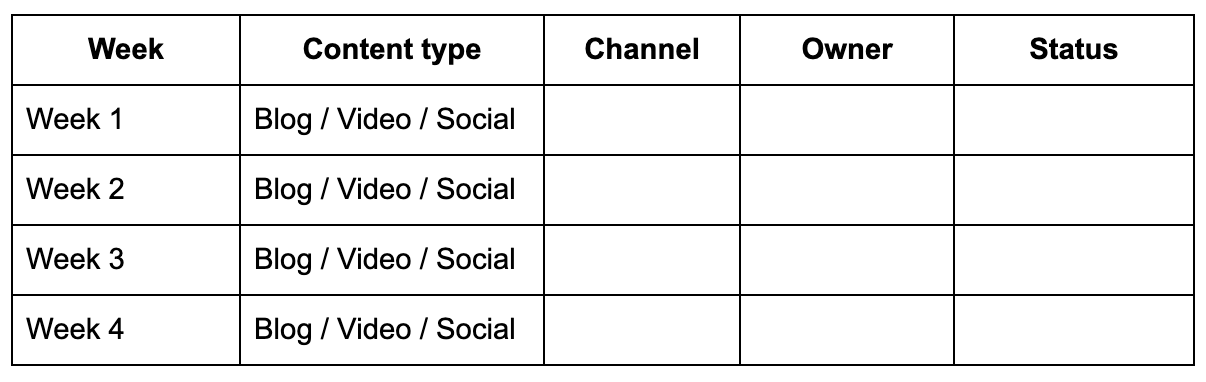
Below is a practical content production template you can copy, paste, and adapt to your own workflow. It’s designed to be flexible, whether you’re a solo creator, a growing team, or managing multiple channels at once.
You can drop this into a doc, spreadsheet, or project management tool and customize it as needed.
1. Content production goals (quarterly or yearly)
Primary objective: (e.g., grow awareness, drive sign-ups, support product adoption)
Secondary objectives: (e.g., improve engagement, support launches, educate users)
Core KPIs:
• Awareness: impressions, reach, views
• Engagement: comments, shares, saves, watch time
• Conversion: clicks, sign-ups, demo requests
2. Audience & engagement notes
Primary audience segment: (Who this content is for)
Key platforms they use: (e.g., LinkedIn, TikTok, YouTube, blog)
Engagement insights:
• Best-performing formats
• Typical content length
• Common questions or pain points
3. Content types & formats
Core formats (repeatable):
• Long-form content (blogs, guides, product pages)
• Short-form video clips
• Social posts (text, carousel, visual)
• Product education (tutorials, walkthroughs)
Hero → repurpose plan:
• 1 hero asset = ___ clips
• ___ social posts
• ___ follow-ups or refreshes
This section keeps your content production focused on reuse, not constant reinvention.
4. Monthly content calendar overview
Month: ___________
Theme or campaign: (e.g., product update, seasonal focus, education series)
5. Channel-specific production rules
Social media content production
• Posting frequency:
• Preferred formats:
• Lead time needed:
Video content production
• Video length range:
• Aspect ratio:
• Caption/subtitle requirements:
Product content
• Review process:
• Approval owners:
• Update frequency:
6. Workflow & ownership
Briefing: Who creates the brief and where it lives
Production: Who writes, records, or designs
Review & approval: Who reviews and how many rounds
Publishing & distribution: Who publishes and promotes
Clear ownership here prevents bottlenecks and keeps content production moving.
7. Review & optimization checkpoints
Monthly review questions:
• What content performed best?
• Where did production slow down?
• What can be reused or refreshed next month?
Quarterly system updates:
• Formats to keep or drop
• Channels to prioritize
• Workflow improvements
You can save this template as your default starting point and reuse it every quarter or year. Once it’s set up, maintaining your content production flow becomes about small adjustments, not constant rebuilding.
Final thoughts
A good content production flow shouldn’t feel heavy; it should make your work easier. Once you’ve mapped out your system and set a rhythm that works, everything else starts to click into place. Less guesswork, fewer last-minute scrambles, and more space to focus on creating content that actually performs.
If you want to keep that momentum going in 2026, Async can help support your content production flow by spotting engagement patterns and smoothing out the process behind the scenes. Set it up once, and let your content work smarter all year long.
News
Berita Teknologi
Berita Olahraga
Sports news
sports
Motivation
football prediction
technology
Berita Technologi
Berita Terkini
Tempat Wisata
News Flash
Football
Gaming
Game News
Gamers
Jasa Artikel
Jasa Backlink
Agen234
Agen234
Agen234
Resep
Download Film

